Skip to content

  • About
    • Our Mission
    • Participating Institutions
    • Collaborations
    • Boards
    • Diversity
    • SCIoI Cluster Reports
    • Labs and Facilities
    • Newsletter
    • Contacts
  • Research
    • SCIoI Disciplines
    • Research Projects
    • Research Structure
    • Research Proposal (2026-2032)
    • Candidate Principles of Intelligence
    • Research Data
    • Final theses
    • Grants & Awards
    • SCIoI Publications
  • Activities
    • Intelligence Lectures
    • Lecture Series
    • Press coverage
    • TV/Radio Coverage
    • SCIoI Fair
    • Punching Cards Podcast
    • SCIoI Talks & Videos
    • Outreach Activities
    • Press Room
  • People
  • Education
    • Doctoral Program
    • Master’s Track
    • Conferences and Collaborations
  • Events
  • News
  • Jobs
  • About
    • Our Mission
    • Participating Institutions
    • Collaborations
    • Boards
    • Diversity
    • SCIoI Cluster Reports
    • Labs and Facilities
    • Newsletter
    • Contacts
  • Research
    • SCIoI Disciplines
    • Research Projects
    • Research Structure
    • Research Proposal (2026-2032)
    • Candidate Principles of Intelligence
    • Research Data
    • Final theses
    • Grants & Awards
    • SCIoI Publications
  • Activities
    • Intelligence Lectures
    • Lecture Series
    • Press coverage
    • TV/Radio Coverage
    • SCIoI Fair
    • Punching Cards Podcast
    • SCIoI Talks & Videos
    • Outreach Activities
    • Press Room
  • People
  • Education
    • Doctoral Program
    • Master’s Track
    • Conferences and Collaborations
  • Events
  • News
  • Jobs
12 events found.

Events Search and Views Navigation

Event Views Navigation

  • List
  • Month
Today
  • June 2020

  • Thu 18
    Thursday Morning Talk
    18 June, 2020 @ 10:00 am - 11:00 am

    Manuel Lopes (hosted by Marc Toussaint): Optimal Behavior Without Optimal Rewards : Artificial Vs Natural

    On ZOOM (Contact communication@scioi.de for link)

    Abstract: Research in robotics and A.I. aims at optimizing very specific task rewards. Intelligent animals have a high degree of curiosity, and recent results have shown that instrumental reward optimization is a poor explanation for their behavior. We can show that to explain empirical results from animals, we need to have the drive to optimize

  • Thu 18
    PI Lecture
    18 June, 2020 @ 4:00 pm - 5:30 pm

    Oliver Brock (SCIoI): Genesis, Goals, and Gossip of SCIoI

    On ZOOM (Contact us for Link)

    Abstract: I would like to give a personal perspective of the scientific motivation and framing of SCIoI and relate them to the research of my lab, the Robotics and Biology Laboratory. But at the same time, I would like to critically question and discuss all of these things, in an attempt to move towards a

  • Tue 23
    For the Public
    23 June, 2020 @ 4:00 pm - 5:00 pm

    PresFutures Forum, SCIoI’s Fishbowl Discussion: “Predictive AI — Crystal Ball To See the Future or a Threat to Civil Rights?”

    Rainer Mühlhoff and John-Dylan Haynes participated in a fishbowl discussion on predictive AI.

  • Thu 25
    25 June, 2020 @ 10:00 am - 11:00 am

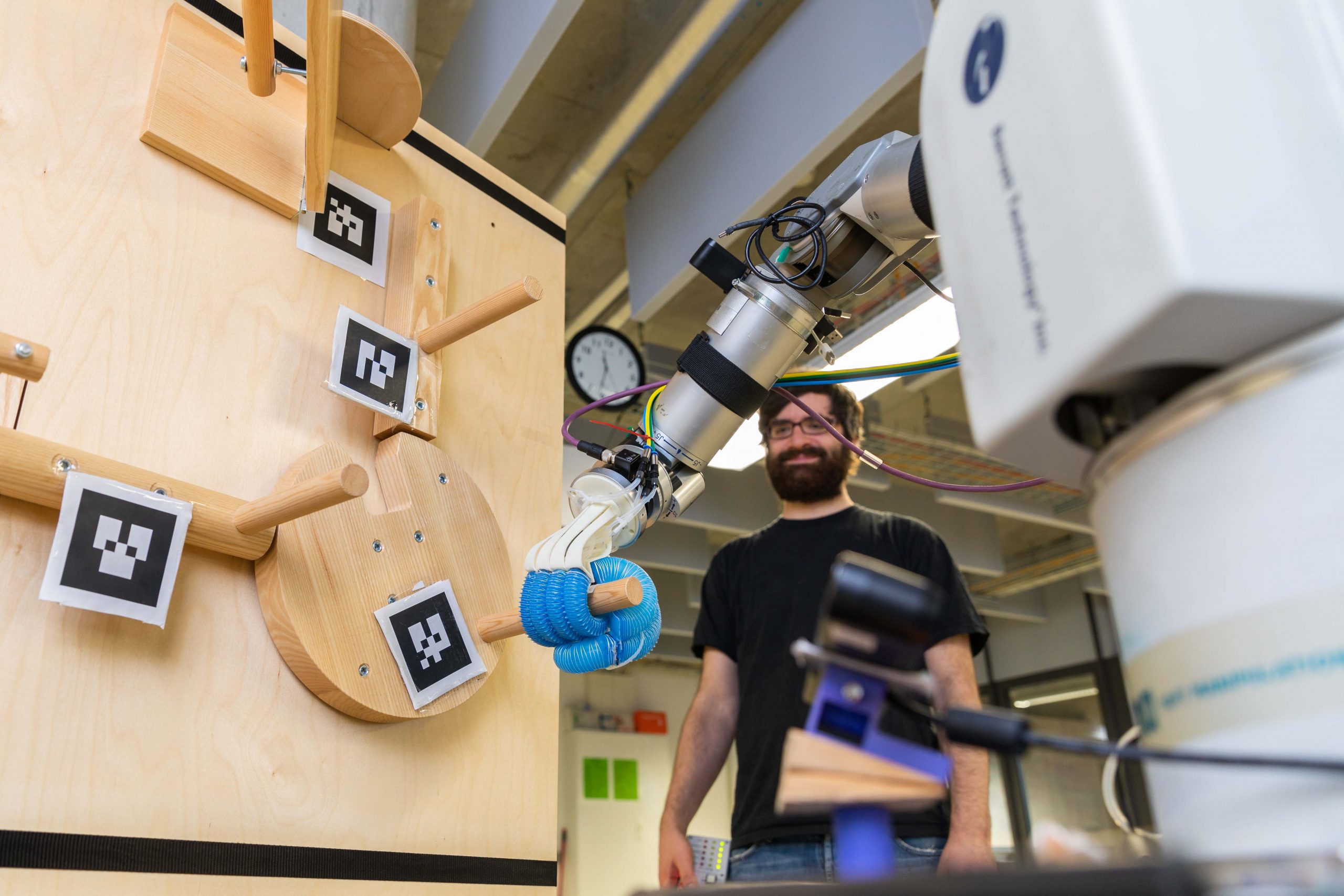
    Thursday Morning Lectures: Dr Utku Culha (Max Planck Inst.): Physical Intelligence on Soft Robots: Order, Functionality, and Adaptation From the Bottom-Up

    On ZOOM (Contact communication@scioi.de for link)

    Abstract: We typically have a clear idea about the final design and functionality of a robot before we start building it. We apply this top-down design approach to a wide range of robotic systems and it allows our robots to be more optimized, autonomous, and programmable. However, if we want to design and actuate multiple

  • Thu 25
    Distinguished Speaker Series
    25 June, 2020 @ 4:00 pm - 6:00 pm

    Jacqueline Gottlieb (Hosted by Martin Rolfs): Curiosity and Information Demand: How We Can Study Them and Why We Should Care

    On ZOOM (Contact us for Link)

    Curiosity and information demand: how we can study them and why we should care A rapidly growing literature has recently emphasized the importance of our sense-making instincts, including complex investigative behaviors such as curiosity, for behavior and brain function. While much of this literature has focused on simple forms of decision making, we explored its

  • July 2020

  • Thu 2
    2 July, 2020 @ 4:00 pm - 5:30 pm

    PI Lecture: Thorsten Pachur (SCIoI): Ecologically Rational Decision Making

    On ZOOM (Contact us for Link)

    Ecologically rational decision making How do we make inferences about a world full of uncertainty and given the mind’s natural bounds in computational abilities? I present a perspective according to which the decision maker is equipped with a repertoire of strategies, containing both simple heuristics and more complex strategies that are adaptive under different ecological

  • Thu 9
    9 July, 2020 @ 10:00 am - 11:00 am

    Thursday Morning Talk: Leon Sixt (Biorobotics Lab, FU Berlin): Opportunities and Challenges in Interpetable ML

    On ZOOM (Contact us for Link)

    Abstract: Deep neural networks underlie many state of the art solutions to hard problems in computer vision, natural language processing or playing Go. Yet, their power comes with a price. Deep networks transform inputs gradually into outputs, using many parameters and intermediary activations. Understanding what a network has learned, how inputs are mapped to outputs,

  • Thu 16
    16 July, 2020 @ 10:00 am - 11:00 am

    Work-in-Progress Talk: Dimitri Coelho Mollo (SCIoI) & Alfredo Vernazzani (Ruhr Universität Bochum): Saving Representational Formats: A Computational Theory

    On ZOOM (Contact us for Link)

    Abstract Most cognitive sciences (including AI) appeal to representations in explaining (or trying to create) systems capable of cognition, and especially of complex, intelligent behaviour. In philosophy, considerable attention has been dedicated to the problem of explaining in scientifically-acceptable ways how representations come to represent what they do. In contrast, there has been much less

  • August 2020

  • Tue 11
    11 August, 2020 @ 9:00 am - 13 August, 2020 @ 6:00 pm

    SCIoI Scientific Networking Days (internal event)

    Internal Event

    The SCIoI Scientific Networking Days event is an internal retreat meant to establish scientific connections among the people and the projects in SCIoI. Through this event, we want to emphasize the importance of establishing scientific connections among SCIoI researchers and promote in-depth scientific discussions and exchanges. During the retreat, the SCIoI executive board will evaluate

  • September 2020

  • Thu 3
    3 September, 2020 @ 10:00 am - 11:00 am

    Thursday Morning Talk with Rico Jonschkowski (Google Brain): Perception in Motion

    On ZOOM (Contact us for Link)

    Title: Perception in Motion Abstract: This is a talk on perception in two parts. Part one exemplifies the "movement" of the field of learning-based robot perception. Here, I will give one example for increasing structural assumptions and one for decreasing them based on our work on differentiable mapping and differentiable resampling. Part two takes the

  • Thu 10
    10 September, 2020 @ 10:00 am - 11:00 am

    Thursday Morning Talk With Benjamin Wild: Social Networks Through Time – Individuality in a Colony of Honey Bees

    On ZOOM (Contact us for Link)

    ABSTRACT: In many social systems, an individual’s role is reflected by its interactions with other members of the group. In many model organisms, and particularly in social insects, the patterns of actions and interactions among individuals are not static but constantly evolving over time. This can be due to the emergence or demise of certain

  • October 2020

  • Thu 22
    Distinguished Speaker Series
    22 October, 2020 @ 4:00 pm - 5:30 pm

    Guy Theraulaz, (CNRS, Toulouse, France. Host: Pawel Romanczuk): Ethological Analysis and Computational Modeling of Social Interactions in Schooling Fish

    Abstract: Swarms of insects, schools of fish and flocks of birds display an impressive variety of collective movement patterns that emerge from interactions among group members. These puzzling phenomena raise a variety of questions about the interaction rules that govern the coordination of individuals’ motion and the emergence of large-scale patterns. While numerous models have

  • Previous Events
  • Today
  • Next Events
  • Google Calendar
  • iCalendar
  • Outlook 365
  • Outlook Live
  • Export .ics file
  • Export Outlook .ics file

Science of
Intelligence

Funded by the Deutsche Forschungsgemeinschaft (DFG, German Research Foundation) under Germany ́s Excellence Strategy – EXC 2020/1 and 2020/2 – Project number 390523135.

Marchstr. 23 – MAR 5-2
10587 Berlin
Email: info@scioi.de
Tel: +49 30 314 70660

  • Instagram Icon
  • Facebook Icon
  • Youtube Icon
  • Twitter Icon

Imprint | Data Protection

Newsletter

Subscribe to our newsletter to receive the latest news from SCIoI.

Subscribe

Useful links

Doctoral Program
Publications
Events
Press Room
Contacts
Jobs and Research Positions