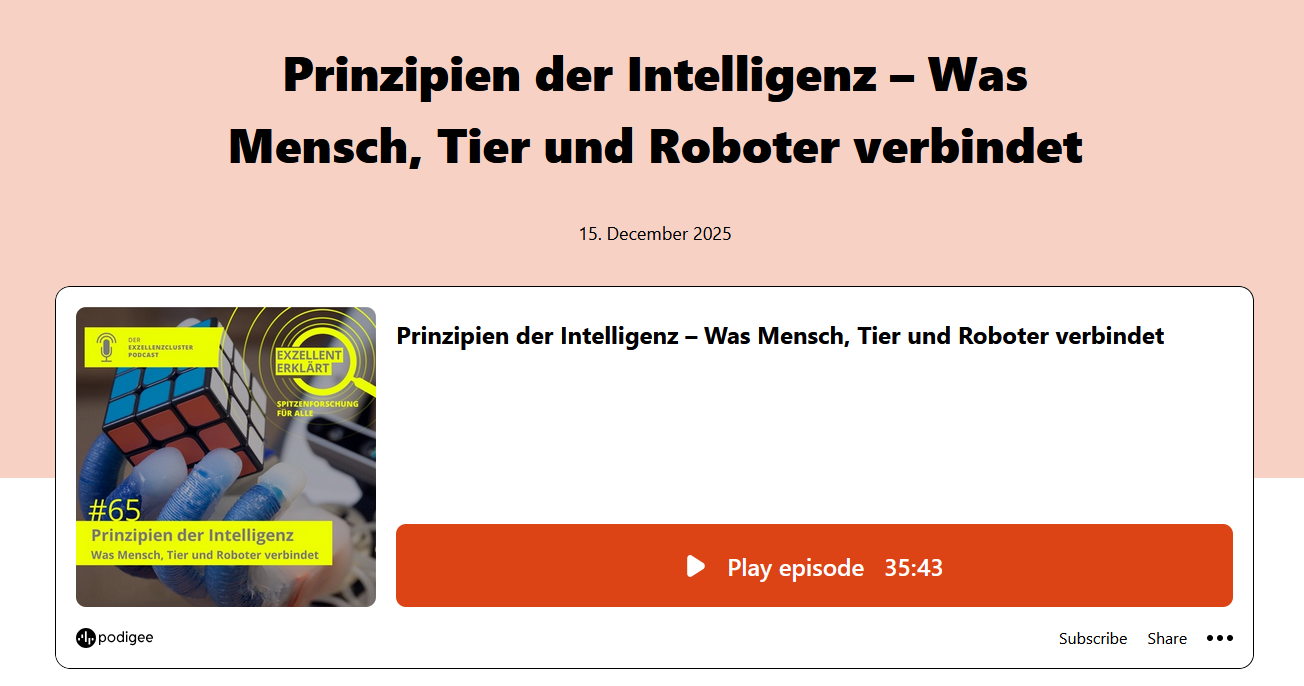
Exploring the principles of intelligence: new podcast episode with SCIoI researchers
What do humans, animals, and machines have in common when they behave intelligently? And can intelligence, despite its many forms, be described through shared principles?
These questions are at the heart of the latest episode of Exzellent erklärt, featuring researchers Oliver Brock and Vito Mengers from Science of Intelligence (SCIoI). The episode takes listeners into the cluster’s core idea: intelligence does not belong to individual components alone, but emerges through their interaction with each other and with the environment.
Oliver Brock, Professor of Robotics at TU Berlin and spokesperson of Science of Intelligence, explains why intelligence research still lacks something other sciences take for granted: a set of broadly accepted principles. Rather than rigid rules, these principles are meant as empirically grounded guidelines, flexible enough to evolve, but strong enough to structure research across disciplines and across biological and artificial systems.
A central concept discussed in the episode is that of “active interconnections.” From fish schools to neural circuits and robots, intelligent behavior often arises not from isolated modules, but from the dynamic relationships between them. Understanding and shaping these relationships, Oliver argues, is key to building systems that are robust, adaptive, and capable of dealing with uncertainty.
This idea is taken further by the second guest, Vito Mengers, a doctoral researcher at SCIoI. He introduces AICON (Active Interconnect), a framework designed to function as an “engine for intelligent behavior.” Instead of relying on exhaustive programming or massive training datasets, AICON focuses on learning through structured interactions, allowing robots to adapt their behavior in real-world situations they have never encountered before.
The episode also addresses a timely question: how close today’s artificial intelligence really is to biological intelligence. While current AI systems can be impressive, the researchers highlight a crucial gap. Biological systems learn quickly, efficiently, and transfer knowledge to new contexts with remarkable ease.
The conversation concludes with a look ahead. Although Science of Intelligence was not extended as a cluster into a new funding period, its conceptual framework continues to shape ongoing research. The principles developed within the cluster, researchers emphasize, have already become part of everyday scientific practice, and will continue to influence how intelligence is studied long after the cluster itself has ended.