Skip to content

  • About
    • Our Mission
    • Participating Institutions
    • Collaborations
    • Boards
    • Diversity
    • SCIoI Cluster Reports
    • Labs and Facilities
    • Newsletter
    • Contacts
  • Research
    • SCIoI Disciplines
    • Research Projects
    • Research Structure
    • Research Proposal (2026-2032)
    • Candidate Principles of Intelligence
    • Research Data
    • Final theses
    • Grants & Awards
    • SCIoI Publications
  • Activities
    • Intelligence Lectures
    • Lecture Series
    • Press coverage
    • TV/Radio Coverage
    • SCIoI Fair
    • Punching Cards Podcast
    • SCIoI Talks & Videos
    • Outreach Activities
    • Press Room
  • People
  • Education
    • Doctoral Program
    • Master’s Track
    • Conferences and Collaborations
  • Events
  • News
  • Jobs
  • About
    • Our Mission
    • Participating Institutions
    • Collaborations
    • Boards
    • Diversity
    • SCIoI Cluster Reports
    • Labs and Facilities
    • Newsletter
    • Contacts
  • Research
    • SCIoI Disciplines
    • Research Projects
    • Research Structure
    • Research Proposal (2026-2032)
    • Candidate Principles of Intelligence
    • Research Data
    • Final theses
    • Grants & Awards
    • SCIoI Publications
  • Activities
    • Intelligence Lectures
    • Lecture Series
    • Press coverage
    • TV/Radio Coverage
    • SCIoI Fair
    • Punching Cards Podcast
    • SCIoI Talks & Videos
    • Outreach Activities
    • Press Room
  • People
  • Education
    • Doctoral Program
    • Master’s Track
    • Conferences and Collaborations
  • Events
  • News
  • Jobs
12 events found.

Events Search and Views Navigation

Event Views Navigation

  • List
  • Month
Today
  • June 2021

  • Thu 3
    PI Lecture
    3 June, 2021 @ 4:00 pm - 5:30 pm

    Pawel Romanczuk (Science of Intelligence), “Is Intelligence Critical? Can Magnets Teach Us Anything About Brains and Swarms?”

    Abstract: More than three decades ago, it was proposed that certain natural systems can be viewed as self-organized critical systems, which self-tune themselves to special regions in parameter space close to so-called critical points, where the behavior of a system exhibits a qualitative change at the macroscopic scale, i.e. it undergoes a phase transition. Over
  • Sat 5
    For the Public
    5 June, 2021 @ 6:30 pm - 7:00 pm

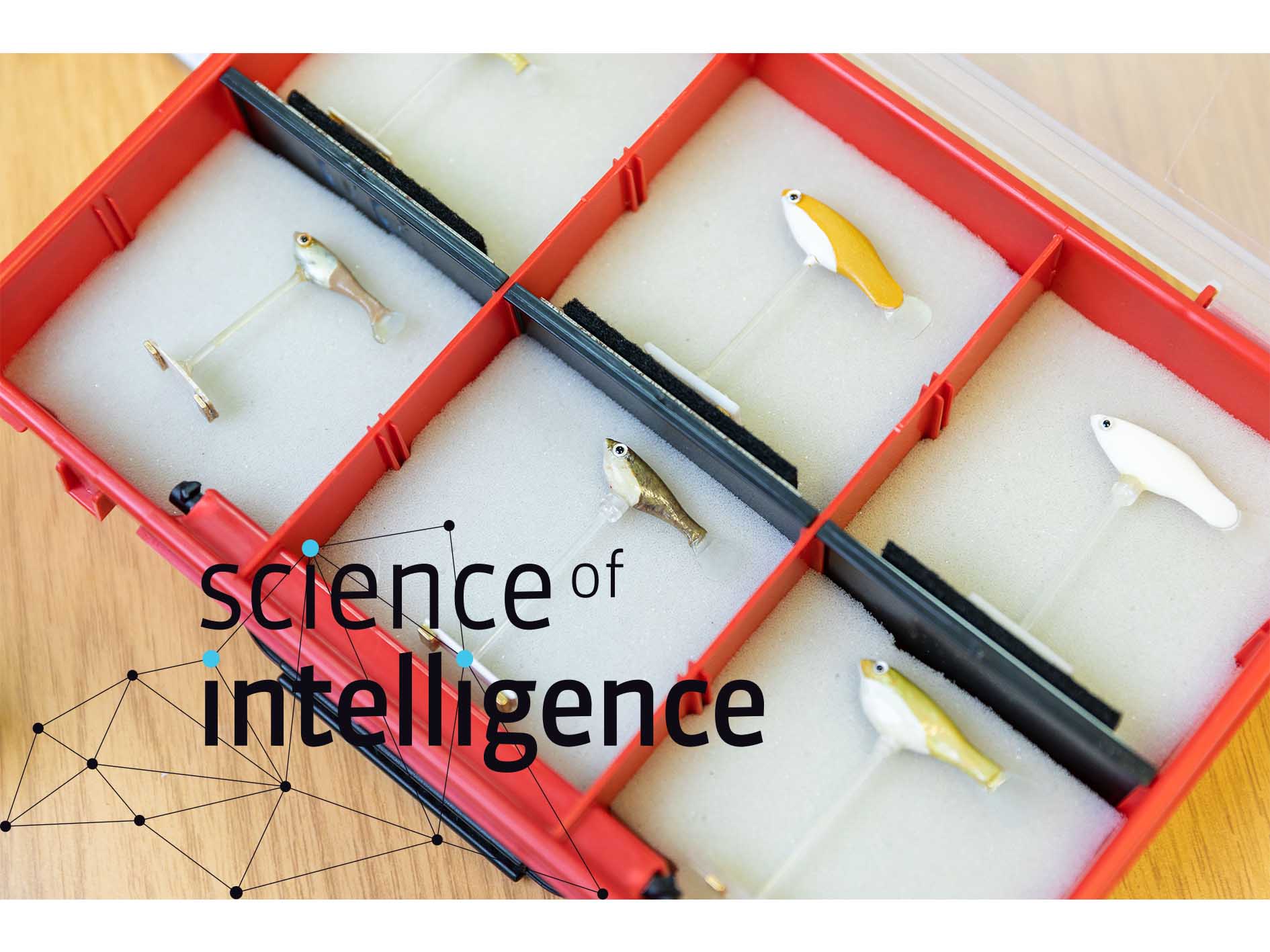
    LNDW 2021: David Bierbach, “ROBOFISH: Mit einem Fischroboter das Schwarmverhalten verstehen”

    ROBOFISH: Mit einem Fischroboter das Schwarmverhalten verstehen (in German, at 6:30pm and at 9:30pm) Um das Gruppenverhalten von Fischen zu studieren, haben wir unter Beteiligung der FU, HU und TU sowie des Leibniz-Instituts für Gewässerökologie und Binnenfischerei (IGB) einen Roboterfisch gebaut. Dieser ist einem Guppy nachempfunden und wird von lebenden Guppys als Artgenosse akzeptiert. Mit

  • Sat 5
    For the Public
    5 June, 2021 @ 7:30 pm - 10:00 pm

    LNDW2021: SCIoI’s Science Pub Quiz

    The SCIoI Science Pub Quiz (7:30–ca.10pm) Join us for a fun evening with Science of Intelligence (SCIoI) and sign up for this special edition of the Science Pub Quiz, organized with SCIoI! What is intelligence? Do beets float in water? Why should you pet your basil? We will be joined by Aravind Battaje and Lynn

  • Sat 5
    For the Public
    5 June, 2021 @ 10:00 pm - 11:00 pm

    LNDW2021: Ralf Kurvers and Pawel Romanczuk: “Collective Intelligence or Collective Stupidity? Swarm intelligence in fish and humans”

    Collective Intelligence or Collective Stupidity? Swarm intelligence in fish and humans (5 June, 10pm) In this talk, Pawel Romanczuk and Ralf Kurvers from our Excellence Cluster will explore swarm intelligence in fish and humans, investigating the role of single individuals and social interactions in collective decisions, also exploring when collectives make good decisions, and when

  • Thu 10
    For the Public
    10 June, 2021 @ 4:00 pm - 5:30 pm

    Talk: Manuel Cebrian, Max-Planck Institute for Human Development: “Time-critical Social Mobilization”

    Title: Time-Critical Social Mobilization Abstract: This seminar explores the physical, behavioral, and computational limits of crowd-assembly for problem-solving. I follow several real-world experiments where we utilized social media to mobilize the masses in tasks of unprecedented complexity. From finding red weather balloons to locating thieves in distant cities to reconstructing shredded classified documents, the potential

  • Thu 17
    Thursday Morning Talk
    17 June, 2021 @ 10:00 am - 11:00 am

    Jose Hernandez-Orallo (Valencia/Cambridge), “The Generality of Natural and Artificial Intelligence: Task Difficulty as the Elephant in the Room”

    On Zoom

    Abstract: Understanding and recreating intelligence is possibly the biggest scientific challenge of our time. Evolution has produced organisms that are highly specialised for some cognitive tasks, whereas others present what has been called general intelligence, with humans identified as the paragon. Artificial intelligence (AI), despite decades of efforts to achieve generality, is still specialised. It

  • Thu 17
    PI Lecture
    17 June, 2021 @ 4:00 pm - 5:30 pm

    Rebecca Lazarides (Science of Intelligente), “Learning in Social Interaction – Emotions, Motivation and Adaptive Learning Support”

     ABSTRACT: Central theories of learning in human agents emphasize that the quality of instruction and interaction between agents is of high importance for effective knowledge transfer. On the other side, within-agent characteristics such as a certain level of emotion and motivation is required to participate in social interactions. Consequently, the interplay between characteristics of social

  • Thu 24
    Distinguished Speaker Series
    24 June, 2021 @ 4:00 pm - 5:30 pm

    Kou Murayama (Universität Tübingen), “A Reward-Learning Framework of Knowledge Acquisition: How We Can Integrate the Concepts of Curiosity, Interest, and Intrinsic-Extrinsic Rewards.”

    On Zoom

    Recent years have seen a considerable surge of research on interest-based engagement, examining how and why people are engaged in activities without relying on extrinsic rewards. However, the field of inquiry has been somewhat segregated into three different research traditions which have been developed relatively independently --- research on curiosity, interest, and trait curiosity/interest. The

  • July 2021

  • Thu 1
    Thursday Morning Talk
    1 July, 2021 @ 10:00 am - 11:00 am

    Rasmus Rothe, PhD (Merantix), “How To Build a (Deep Tech) Startup”

    On Zoom

    Abstract: Rasmus Rothe is Co-Founder at Merantix, the Artificial Intelligent Venture Studio. In this talk he will give insight into how a deep tech startup is built via ideation, incubation and scaling, and the specifics and challenges of working with technology AI in the process. BIO: Rasmus Rothe is the co-founder and CTO of Berlin-based Merantix,

  • Thu 1
    PI Lecture
    1 July, 2021 @ 4:00 pm - 5:30 pm

    Guillermo Gallego (Science of Intelligence), “Current Status of Event-Based Vision Research”

    Abstract: Event-based cameras, also called neuromorphic cameras or silicon retinas, are novel vision sensors that mimic functions from the human retina and offer potential advantages over traditional cameras (low latency, high speed, high dynamic range, bandwidth savings, low power, etc.). My previous talk was about event-based cameras for Spatial AI. In this talk I will

  • Thu 15
    Thursday Morning Talk
    15 July, 2021 @ 10:00 am - 11:00 am

    Dimitri Coelho Mollo (SCIoI), “Modelling Intelligence: The Good, the Bad, and the Plural”

    Abstract:  I argue that artificial intelligence research has been both fuelled and hindered by the use of ‘model tasks’, that is, tasks the solution of which are taken to be sufficient for, or at least indicative of intelligence. Before AI proper, cybernetics explored model tasks involving basic real-time and world-involving action control aimed at the

  • Thu 15
    PI Lecture
    15 July, 2021 @ 4:00 pm - 5:30 pm

    Heiko Hamann (Science of Intelligence), “Group Performance and Scalability in Collective Systems”

    Abstract: Scalability can be challenging in groups of collaborating agents, such as animals, robots, or computers. While a small group may work efficiently together, a bigger group may be slowed down due to increased needs to communicate and synchronize or due to other scarce shared resources. We go through a number of examples for observed

  • Previous Events
  • Today
  • Next Events
  • Google Calendar
  • iCalendar
  • Outlook 365
  • Outlook Live
  • Export .ics file
  • Export Outlook .ics file

Science of
Intelligence

Funded by the Deutsche Forschungsgemeinschaft (DFG, German Research Foundation) under Germany ́s Excellence Strategy – EXC 2020/1 and 2020/2 – Project number 390523135.

Marchstr. 23 – MAR 5-2
10587 Berlin
Email: info@scioi.de
Tel: +49 30 314 70660

  • Instagram Icon
  • Facebook Icon
  • Youtube Icon
  • Twitter Icon

Imprint | Data Protection

Newsletter

Subscribe to our newsletter to receive the latest news from SCIoI.

Subscribe

Useful links

Doctoral Program
Publications
Events
Press Room
Contacts
Jobs and Research Positions