What real-world environments reveal about decision-making
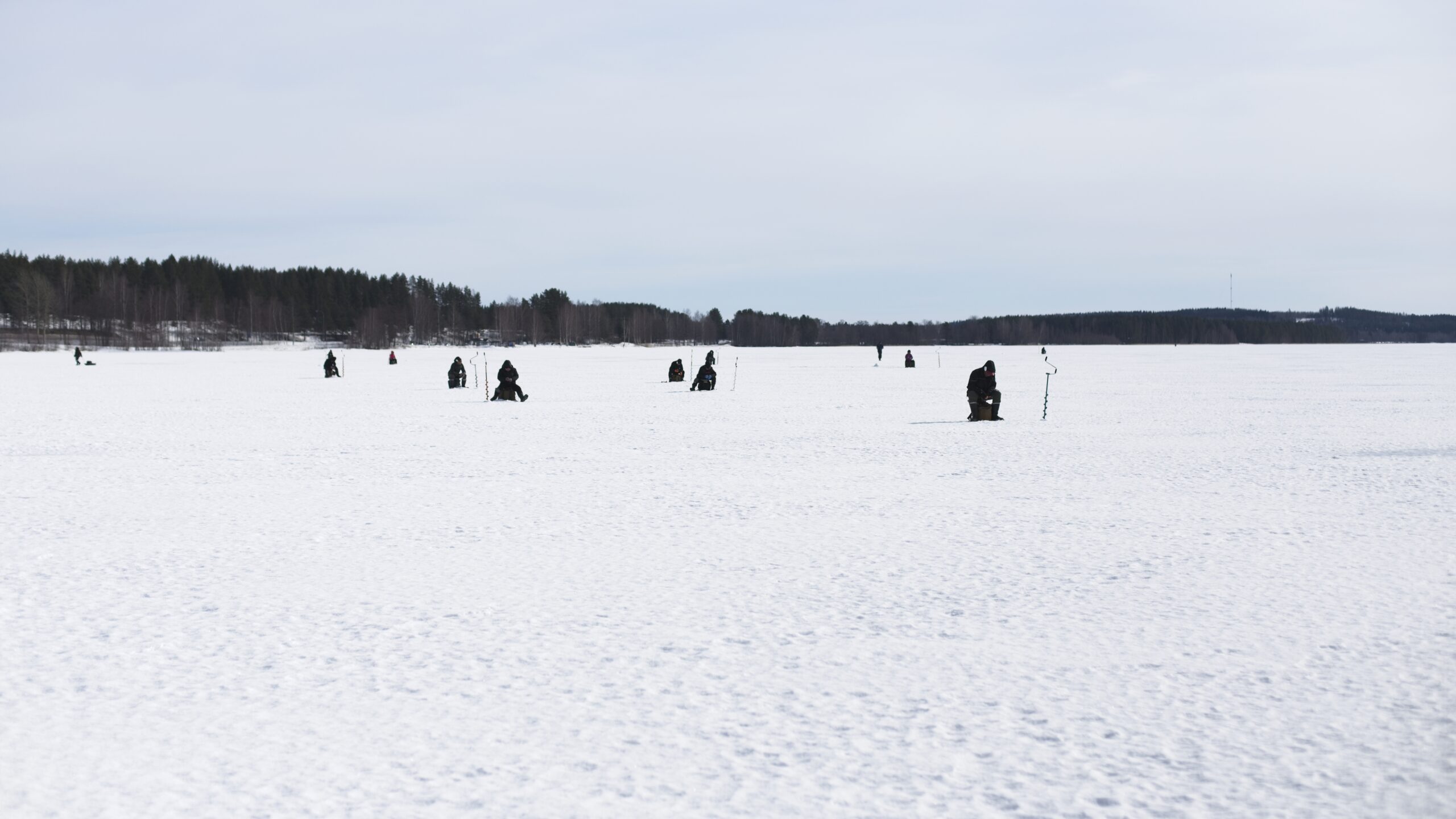
During winter, Finland’s frozen lakes become busy arenas where hundreds of people compete to catch fish, an environment that provides researchers with a unique opportunity to observe decision-making in the real world. This setting has several advantages; ice is open and relatively simple, there are few distractions, and the fishermen’s goal is clear: catching as many fish as possible. This makes it pretty straightforward for researchers to follow participants’ choices without the complexity of a laboratory experiment.
In order to better understand decision-making, scientists from SCIoI and from the Center for Adaptive Rationality at the MPIB travelled to Finland and equipped ice fishers with GPS devices and wearable cameras, thus managing to record hundreds of fishing trips and more than 16,000 decisions about where to fish, over a period of two years. In a new paper, the scientists, including SCIoI members Dominik Deffner, Felicie Dhellemmes, and Ralf Kurvers have reviewed these tracking technologies and statistical tools as innovative frameworks to investigate the mechanisms of real-life decision-making.
Thanks to this large amount of data, the researchers discovered that both personal experience and social information influenced participants’ choices. When a fisher caught a fish at a particular location, they were more likely to stay there and less likely to return to places where they had been unsuccessful. At the same time, seeing other people gathered in one area could attract fishers, especially when their own fishing was not going well.
The researchers also discovered that people’s decisions could change the environment itself. When fishers stayed for a long time in a successful location, fish became more concentrated there, but they also became less likely to bite. This created a cycle in which human behavior affected the environment, which then influenced later decisions.
The ice-fishing research shows how real-world environments can reveal aspects of decision-making that are difficult to observe in laboratories. By combining direct observation, tracking technology, and decision models, researchers can better understand how people use experience, social cues, and environmental information when making choices.