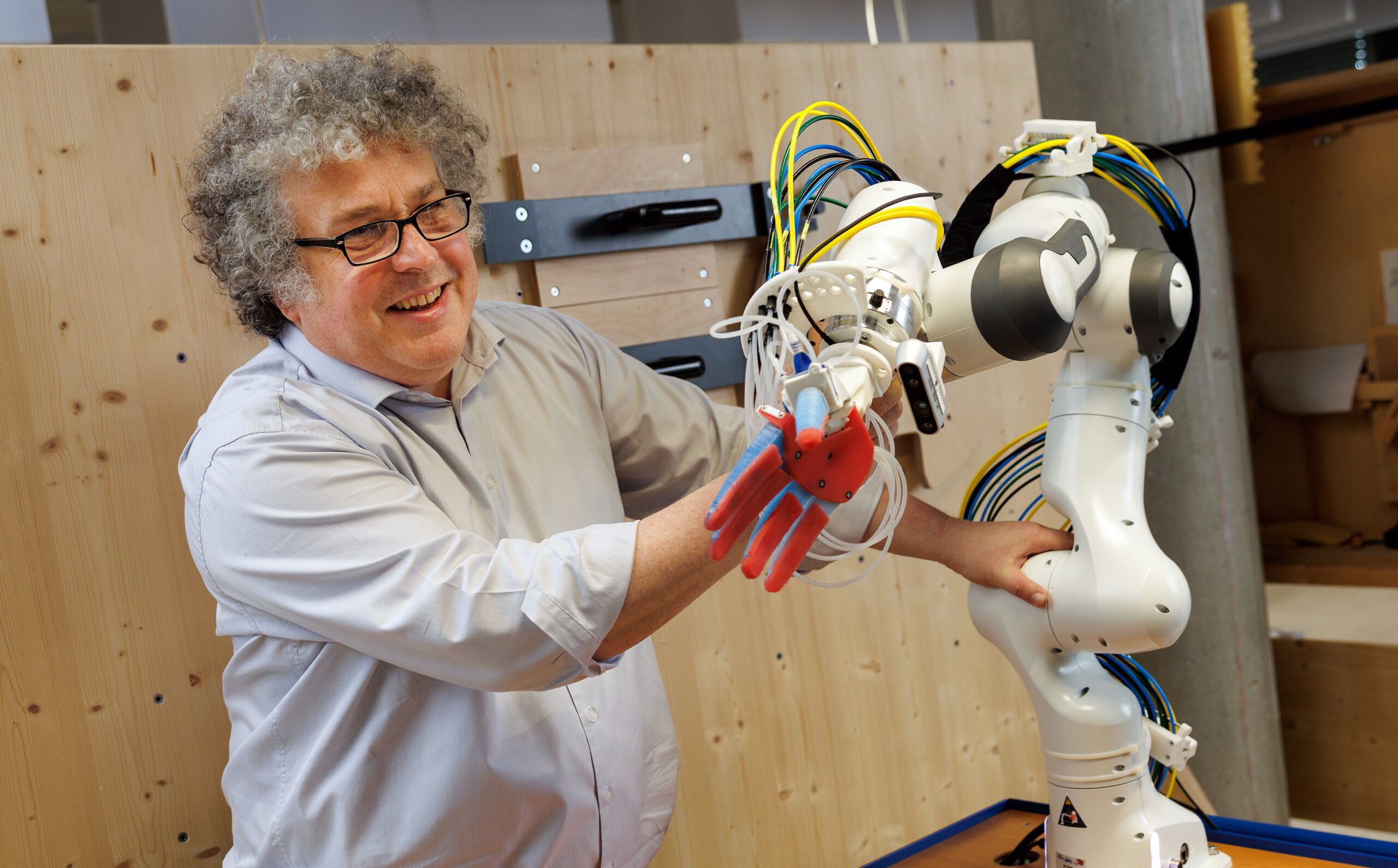
Why dancing robots are the wrong measure of progress
In a new interview with FluxFM, Science of Intelligence (SCIoI) spokesperson Oliver Brock explains why spectacular humanoid robots are often judged by the wrong standards.
Berlin-based radio station 100,6 FluxFM reaches an urban, culturally engaged audience with a mix of music, pop culture, news and debates on the issues shaping society, from digitization to sustainability and mobility. Its interest in humanoid robots is therefore not surprising: few technologies currently sit so visibly at the intersection of innovation, media spectacle and public expectation.
In the interview, Oliver Brock, spokesperson of the Cluster of Excellence Science of Intelligence (SCIoI) and professor of computer science specializing in robotics and artificial intelligence at Technische Universität Berlin, takes a closer look at the robot revolution currently filling news feeds.
Humanoid robots dance, walk reliably or even portion and sell popcorn to passers-by. The videos are impressive. But according to Oliver, they often reveal less about the actual state of robotics than we might think.
The problem is not necessarily that the videos are fake. It is that they encourage us to use the wrong benchmark. A robot performing a carefully prepared sequence of movements may still be unable to deal with the unpredictable details of everyday life: a misplaced object, a slippery glass, a drawer that sticks or a room it has never seen before.
This is where the real challenge begins. Human-like movement is highly visible, but intelligence is not simply the ability to execute an elegant routine. It lies in adapting to unfamiliar situations, learning from physical interaction and responding appropriately when reality does not behave as expected.
That distinction matters at a moment when companies increasingly present humanoid robots as the next major technological leap after generative AI. Some applications may indeed become useful. But polished demonstrations and ambitious promises should not be confused with robust real-world intelligence.
The interview offers a timely reality check: the most important question is not necessarily whether a robot can impress us on camera, but whether it can make sense of the world around it.
Listen to the German-language FluxFM interview:
“Viele der Fortschritte in der Robotik sind inszeniertes Marketing”
Interview by Marius Legowski, broadcast on 2 June 2026.
Read more on the topic:
– Robots that dance, but can’t pour juice: Why the hype around AI machines falls short
Featured Image: Copyright SCIoI/ Michael Setzpfand