• Giovanni Beltrame (Polytechnique Montreal), “Field Collective Robotics: Challenges and Applications”

    Hot Topics in Intelligence Research
    SCIoI, Marchstraße 23, 10587 Berlin, Room 2.057

    Giovanni Beltrame is a Professor in the Department of Computer and Software Engineering at Polytechnique Montréal, where he leads the Making Innovative Space Technology (MIST) Laboratory. At MIST Lab, Giovanni is conducting projects in collaboration with industry and government agencies in areas such as robotics, disaster response, and space exploration. His research interests include the

  • Stephen M. Fiore (University of Central Florida), “Studying Artificial Social Intelligence: Understanding and Examining Social Cognitive Processes in Human-Machine Collaborations”

    Hot Topics in Intelligence Research
    SCIoI, Marchstraße 23, 10587 Berlin, Room 2.057

    In this presentation Stephen M. Fiore will provide an overview of a body of research in social cognition and its relation to developing artificial social intelligence. In the rapidly evolving landscape of artificial intelligence (AI), an important research direction is the development of systems that can work alongside and collaborate with humans as actual teammates.

  • Wannes Ooms (KU Leuven Centre for IT & IP Law -Imec): A General Introduction to the EU AI Act

    Thursday Morning Talk
    Marchstraße 23, 10587 Berlin, Room 2.057

    The EU AI Act introduces new obligations for providers and deployers of AI systems. In this presentation, we will discuss the scope of the AI Act, the different qualifications of AI systems under the act and the related obligations or requirements. We also provide a look ahead at key deadlines, the status of standards and


  • Maarten Sap (Carnegie Mellon University), “Artificial Social Intelligence? On the Challenges of Socially Aware and Ethically Informed LLMs”

    Hot Topics in Intelligence Research
    SCIoI, Marchstraße 23, 10587 Berlin, Room 2.057

    Modern AI systems such as LLMs are pervasive and helpful, but do they really have the social intelligence to seamlessly and safely engage in interactions with humans? In this talk, Maarten Sap will delve into the limits of social intelligence of LLMs and how we can measure and anticipate their risks. He will introduce Sotopia,

  • Goldie Nejat (University of Toronto), “Paging the Socially Assistive Robots: Intelligent and Persuasive Social Robots for Healthcare and Beyond”

    Hot Topics in Intelligence Research
    SCIoI, Marchstraße 23, 10587 Berlin, Room 2.057

    The world is experiencing a silver tsunami: rapid population aging. As the world’s older population significantly increases, dementia is becoming one of the fastest growing diseases, with no cure in sight. Socially assistive robots are a unique disruptive innovation that are becoming a crucial part of everyday society, especially in a post-pandemic world, aiding people

  • Tucker Hermans (University of Utah, NVIDIA), “Learning and Planning With Relational Dynamics Models for Robot Manipulation”

    Hot Topics in Intelligence Research
    SCIoI, Marchstraße 23, 10587 Berlin, Room 2.057

    More info will follow soon. This talk will take place as part of SCIoI member Svetlana Levit’s seminar “Selected Topics in Robot Learning,” which explores how advances in machine learning are helping robots operate in new environments, learn new behaviors, and adapt to changing conditions.

  • Agnieszka Wykowska (the Italian Institute of Technology, Genoa), “Using Humanoid Robots To Study Human Cognition”

    Hot Topics in Intelligence Research
    SCIoI, Marchstraße 23, 10587 Berlin, Room 2.057

    Humanoid robots have recently received a lot of attention and enthusiasm in the robotics community and beyond. Indeed, with new technological advancements, they hold the promise to become our assistants in daily lives, as general-purpose machines. In this talk, however, Agnieszka Wykowska will focus on a different, less explored, way of using humanoids - as

  • Marina Papadopoulou (University of Tuscia), “Behavioural Rules Underlying Self-Organized Animal Collectives”

    Thursday Morning Talk
    SCIoI, Marchstraße 23, 10587 Berlin, Room 2.057

    From the foraging of ungulates and primates to the bait balls of fish and the murmurations of starlings, the dynamics of animal groups fascinate us with the mystery of their underlying social interactions. Identifying unique and common traits across systems can help us understand the self-organized mechanisms of their emergence, as well as the ecological

  • Julten Abdelhalim, “Mastering Confident & Quick-Witted Communication in Academia” Workshop

    Thursday Morning Talk
    SCIoI, Marchstraße 23, 10587 Berlin, Room 2.057

    In this one-hour workshop, a toolbox of best-practise techniques for confident communication skills will be presented. This will equip attendees with a repertoire of rhetorical tools to communicate confidently and quick-wittedly in stressful situations. Participants will learn strategies to handle challenging questions and optimise their performance during academic debates. Another aim is to tackle dealing

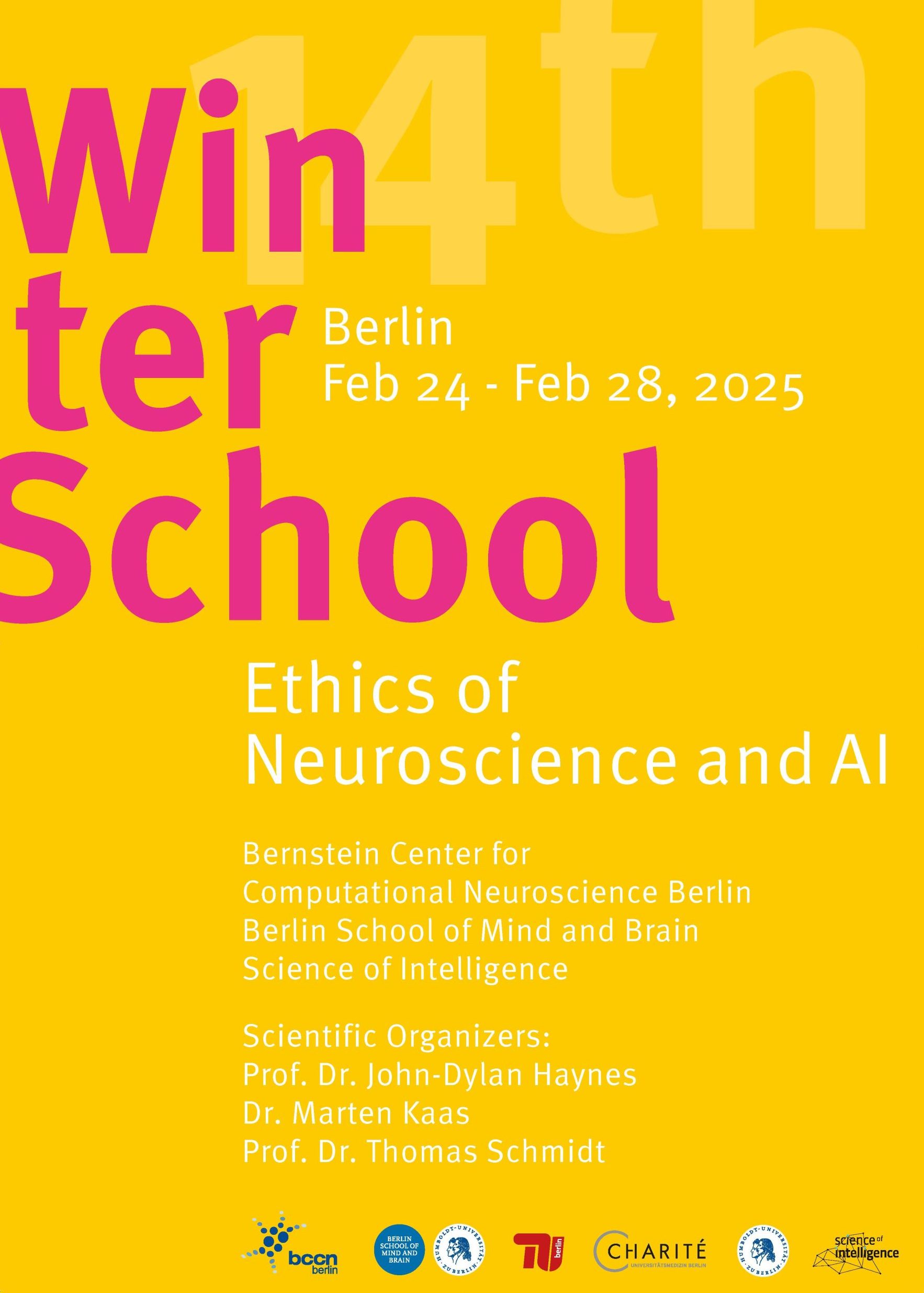
  • Winter School “Ethics of Neuroscience and AI” 2025

    External Event
    Campus Nord of Humboldt-Universität zu Berlin at Ostertag-Haus, Philippstr.12, House 4 10115 Berlin

    Science of Intelligence, the Berlin School of Mind and Brain and the Bernstein Center for Computational Neuroscience are happy to invite to the Berlin Winter School "Ethics of Neuroscience and AI" 2025. The Winter School is a five days conference which covers a broad field of topics from philosophical ethics to ethics of research and

  • Florian Engert (Harvard University), “Attentional Switching in Larval Zebrafish”

    Distinguished Speaker Series

    Decision making strategies in the face of conflicting or uncertain sensory input have been successfully described in many different species.  Here we analyze large behavioral datasets of larval zebrafish engaged in a ‘coherent dot’ optomotor assay. We find that animal performance is bimodal and can be separated into two ‘states’, an engaged state where performance

  • Jonas Kuckling (University of Konstanz), “Living on the Edge – Scalability and Two-Phase Performance in Multi-Robot Systems”

    Thursday Morning Talk
    SCIoI, Marchstraße 23, 10587 Berlin, Room 2.057

    Scalability is often lauded as one of the advantages of decentralized multi-robot systems and robot swarms. Theory and many experimental works predict that with increasing swarm density, we will observe a gradual decay of performance. In our work, we have taken a closer look at the scalability of robot swarms in different settings and we