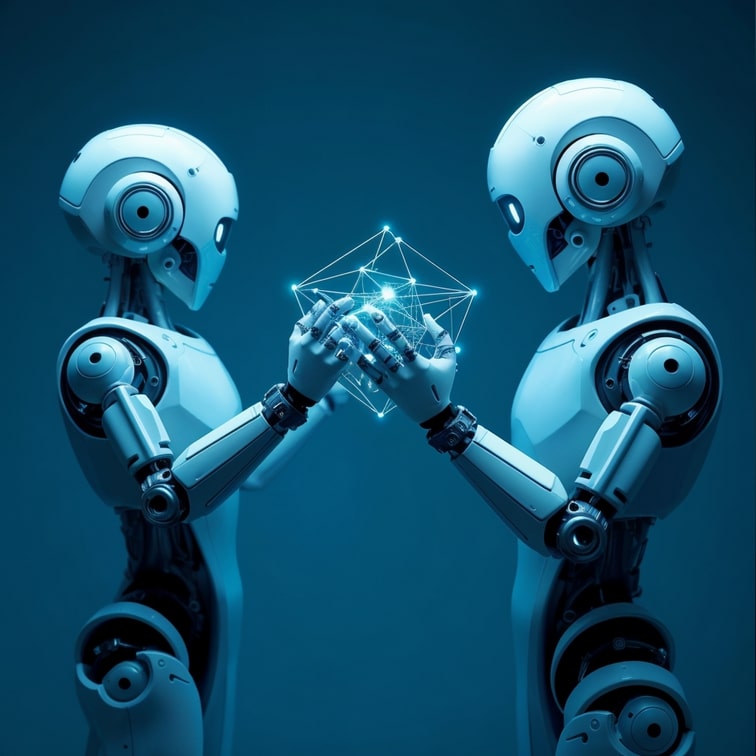
More details to follow. This talk is part of David Mezey's course “Introduction to Modeling Collective Behavior, ” a seminar on collective behavior research, combined with multiple interactive elements. Image created with DALL-E by Maria Ott.
|
Monday
|
Tuesday
|
Wednesday
|
Thursday
|
Friday
|
Saturday
|
Sunday
|
|---|---|---|---|---|---|---|
|
0 events,
|
1 event,
-
More details to follow. This talk is part of David Mezey's course “Introduction to Modeling Collective Behavior, ” a seminar on collective behavior research, combined with multiple interactive elements. Image created with DALL-E by Maria Ott. |

0 events,
|
0 events,
|
1 event,
-
Abstract Understanding the computational principles of embodied intelligence is central to advancing robotic systems that perceive and act in complex environments. This talk explores key principles—low power consumption, robustness, and generalizability—as they emerge in the context of motion perception and action. For visual navigation, evidence is presented that challenges the conventional SLAM paradigm, which relies |
0 events,
|
0 events,
|
|
0 events,
|
1 event,
-
In this talk Jens Krause will discuss the adaptive value of collective behaviour from different perspectives. One perspective is the potential ability of groups or collectives to make better and even faster decisions. In this context Jens will show some of the modelling approaches to explain collective intelligence and the empirical support for them in |
0 events,
|
1 event,
-
Martina Poletti's talk will focus on active foveal vision. Vision is an active process even at its finest scale in the 1-deg foveola, the visual system is primarily sensitive to changes in the visual input and it has been shown that fixational eye movements reformat the spatiotemporal flow to the retina in a way that |
1 event,
-
Artificial intelligence and robotics have been making great progress in recent years but how close are we to emulating human intelligence? This talk will explore the similarities and differences between humans and AIs and discuss the development of biomimetic cognitive systems that more directly think and behave like us. A key focus will be on |
0 events,
|
0 events,
|
|
0 events,
|
1 event,
-
Andrew King is a scientist driven by curiosity, exploring questions across species, contexts, and methods. His research group investigates how and why individuals engage in collective behaviour, using a wide range of systems, perspectives, and tools. In this seminar, he will present their fundamental work in behavioural biology, as well as its applied themes, including |
0 events,
|
1 event,
-
Jennifer Groh (Duke University) Hearing works in concert with vision, such as when we watch someone’s lips move to help us understand what they are saying. But bridging between these two senses poses computational challenges for the brain. One such challenge involves movements of the eyes – every time the eyes move with respect to the head, |
1 event,
-
There is growing interest in applying AI technologies to the control of intelligent robotic systems. While this research has led to promising developments, it still faces major challenges due to its heavy reliance on learning from limited datasets—often dominated by visual information. In this talk, I will introduce "Info-Embodiment" as a new research framework for |
0 events,
|
0 events,
|
|
0 events,
|
1 event,
-
Swarm robotics investigates how large numbers of relatively simple, autonomous robots can coordinate to complete complex collective tasks. In this lecture, we explore how models of collective behavior can guide the design of such systems. We highlight how modeling collective behavior is not only a tool for understanding natural systems, but a powerful method to |
0 events,
|
0 events,
|
0 events,
|
0 events,
|
0 events,
|
|
0 events,
|
0 events,
|
0 events,
|
1 event,
-
Michael Brecht (BCCN Berlin) will present data on a systemic investigation of brains and of grasping behavior in elephants. The analysis of sensory nerves suggests that elephants are extremely tactile animals. In elephants, trunk whisker length is lateralized as a result of heavily lateralized trunk behaviors. The elephant trunk tip appears to be represented by |
0 events,
|
0 events,
|
0 events,
|
|
0 events,
|
1 event,
-
This event has been postponed to 29 July 2025. How should we think about Ethics when Machines become part of our social worlds? Alan Winfield and Dafna Burema will explore the ethical and societal dimensions of robotics and AI in an interactive fishbowl and in conversation with Master`s students of the course “Introduction to Modeling |
0 events,
|
0 events,
|
0 events,
|
0 events,
|
0 events,
|