SCIoI member Julia Rodriguez Buritica receives best poster award at VNOP Conference 2026
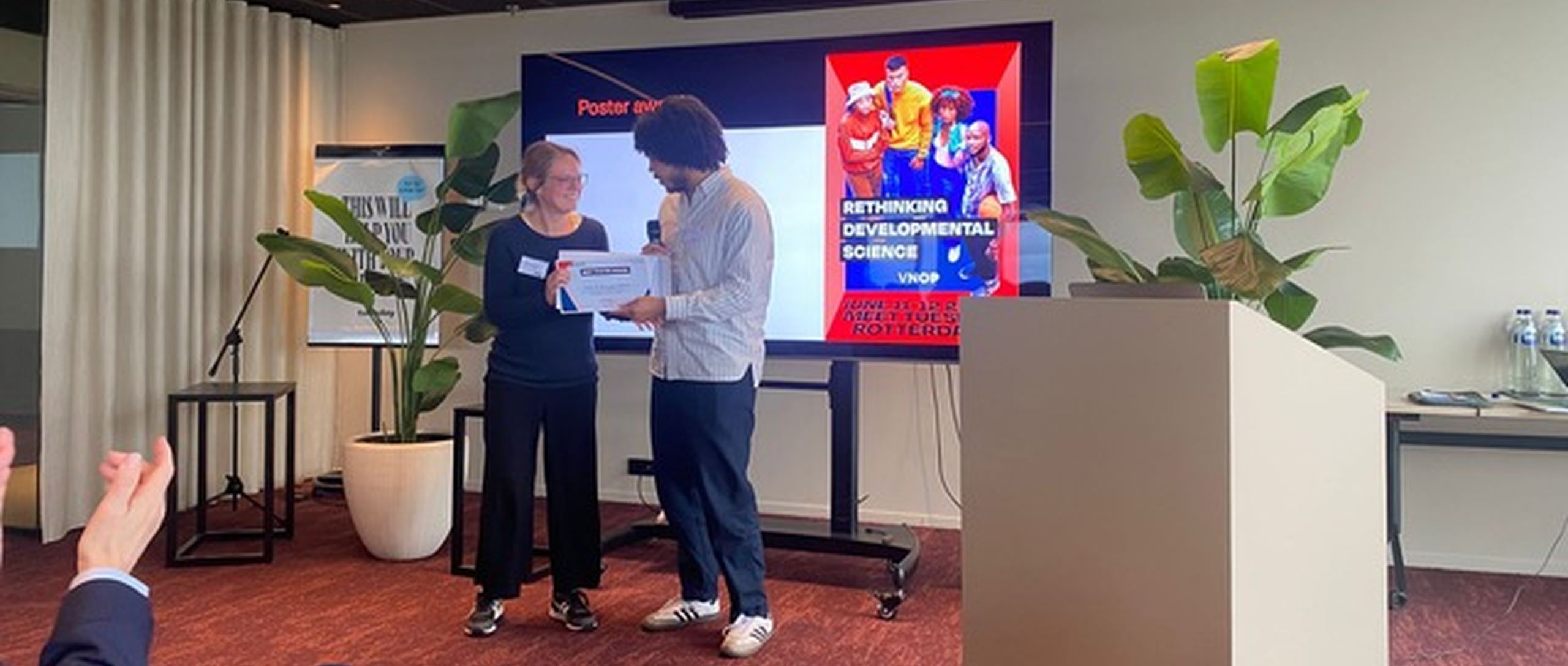
Science of Intelligence (SCIoI) member and Principal Investigator Julia Rodriguez Buritica has received a best poster award at the VNOP Conference 2026, with the theme “Rethinking Developmental Science: How can we grow with the world around us?”, held on 11–12 June in Rotterdam.
The awarded poster presented the current status of Julia’s SCIoI project, “Observational learning in developing humans and artificial agents.” Within the project, she and her fellow researchers investigate how developing humans, and potentially artificial agents, learn from observing the actions and outcomes of others.
Observational learning is one of the most efficient ways intelligent beings acquire new behavior. Instead of relying only on trial and error, children can learn by watching what others do, what succeeds, and what fails. This allows them to avoid unnecessary risks, acquire useful skills more rapidly, and build on the experiences of previous generations. In this sense, observational learning is a mechanism of individual development, but also a foundation for cultural transmission.
At SCIoI, Julia and her collaborators study these processes in both children and artificial agents. Using a foraging task in virtual reality, the project investigates how learners integrate observed information, for example, which food items others select, and what outcomes follow from these choices. The same experimental framework can be used to study human behavior and to implement comparable learning dynamics in artificial agents.
The preliminary synthetic and analytic results presented in Rotterdam suggest that the value of social learning depends on several interacting factors: the kind of information being observed, the model from which the learner is learning, and the learner’s own ability to draw on previous experiences. In other words, learning from others is not simply a matter of copying. It is a dynamic process in which the learner evaluates what is observed, who is being observed, and how this new information fits with what they already know.
This makes the project highly relevant across disciplines, connecting developmental psychology, cognitive neuroscience, computational modeling, and robotics. By comparing observational learning in children and artificial agents, the project contributes to a better understanding of how intelligence develops through social interaction, and how artificial systems might one day learn more flexibly from human behavior.
Julia is a psychologist and cognitive neuroscientist. Her research focuses on how humans learn from their own and others’ experiences across development, using behavioral, computational, and neural measures including EEG and fMRI. At SCIoI, she studies observational learning in developing humans and artificial agents.